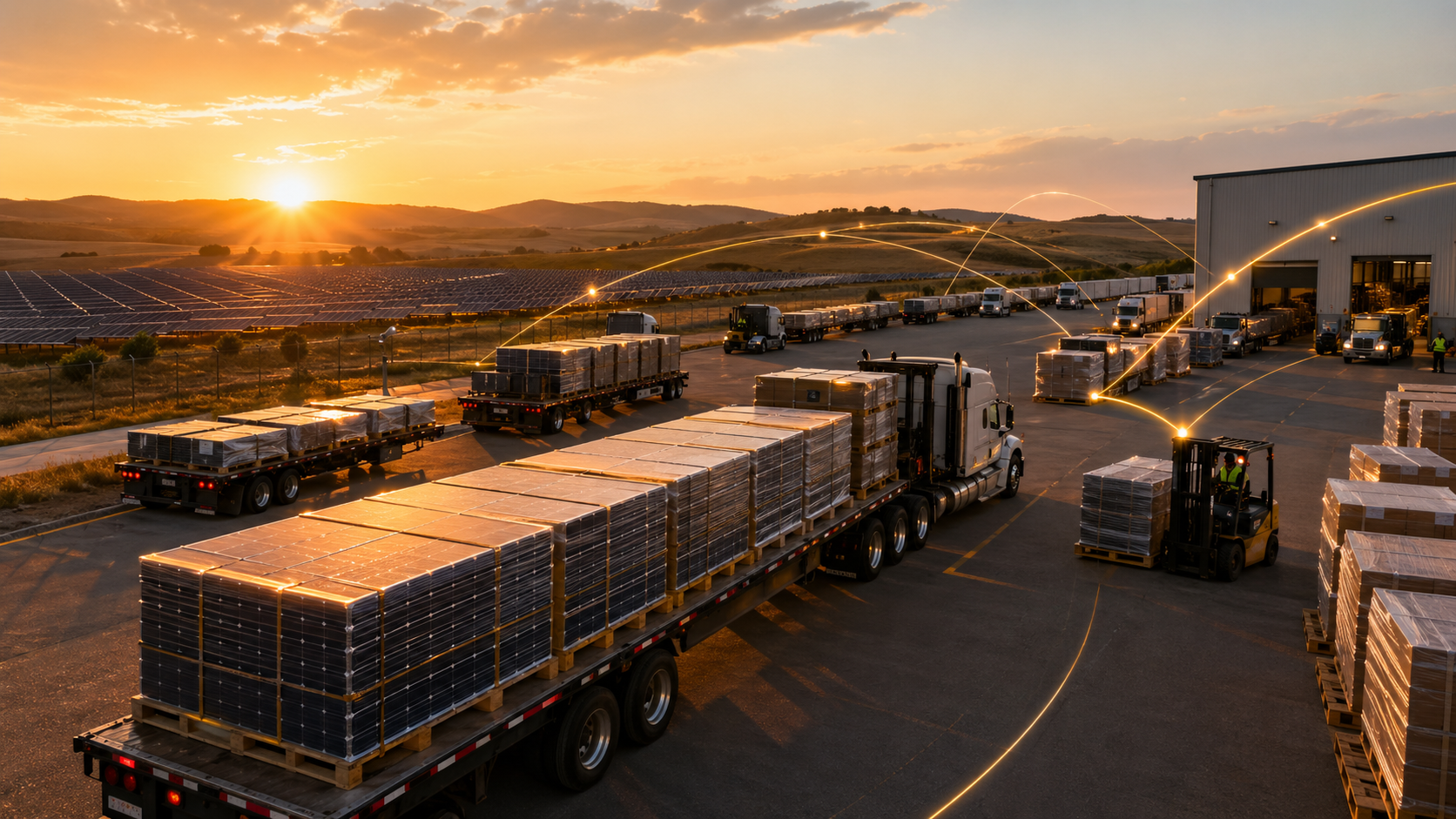
The better question is not only, "What will the truck cost?" It is, "What will it cost to get the material from where it is now to where the project needs it, without creating a schedule problem?"
The Main Information Needed for a Solar Freight Quote
Most solar freight quotes start with the same basics as any freight move: origin, destination, dates, dimensions, weight, and commodity. For utility-scale and commercial solar projects, that is only the first layer.
The quote also needs to account for the project path. Many large solar shipments are imported in containers, drayed from port to a warehouse, stored until the project is ready, staged closer to the construction window, and delivered to the job site in scheduled waves.
| Quote Detail | What to Provide |
|---|---|
| Project role | Developer, EPC, procurement, logistics, analyst, or owner contact |
| Shipment origin | Overseas supplier, port, warehouse, domestic vendor, or current storage location |
| Handoff terms | Whether material is DDP to site, DDP to warehouse, port pickup, or buyer-managed freight |
| Project location | Job site address, ZIP code, gate instructions, and site contact |
| Equipment | Modules, racking, inverters, transformers, breakers, cable, batteries, or mixed material |
| Volume | Containers, pallets, truckloads, megawatt size, or project phase |
| Packaging | Pallets, crates, skids, bundles, reels, containers, stackable or non-stackable |
| Dimensions and weight | Packaged dimensions and total weight by unit or load |
| Timing | Arrival date, project start date, delivery window, and trucks needed per day |
| Storage or staging | Whether material goes direct, into warehouse, or through a staging plan |
| Site access | Road condition, gate access, truck room, one-way roads, mud, rain, laydown space |
| Unloading | Who unloads, what equipment is available, and how many trucks the site can receive |
| Inventory needs | Project-level inventory reporting, release process, photos, serials, or audit documentation |
The key is to separate what is known from what is still unknown. Early in a project, the exact number of trucks, warehouse location, delivery sequence, or storage duration may not be finalized. That is normal. But those unknowns should be discussed before the quote is treated as final.
Who This Quote Is Really For
The main reader for this post is usually a solar developer, EPC, procurement lead, logistics coordinator, or analyst trying to plan an upcoming project. In real projects, the person asking for the quote may not be a full-time logistics person. They may be a procurement manager who bought the equipment and is suddenly responsible for getting it stored, staged, and delivered.
That matters. A good quote should help the project team understand the plan, not bury them in freight jargon.
The project may be a smaller commercial job, but the bigger pain usually shows up on larger projects. These can range from tens of megawatts to gigawatt-scale pipelines where the freight plan is not one shipment. It is a sequence of container arrivals, warehouse receipts, inventory releases, outbound truckloads, site appointments, and delivery exceptions.
On those projects, the question is rarely, "Can someone move this load?" The question is, "Can the material arrive, sit, stage, and deliver in the right order without slowing down construction?"
Basic Freight Quote vs. Solar Project Freight Quote
A basic freight quote usually prices a shipment from point A to point B. It assumes the freight is ready, the pickup and delivery locations can handle the truck, and the schedule is fairly straightforward.
A solar project freight quote has more moving parts. It may include imported containers, drayage from port, warehousing, long-term storage, safe harbor inventory, project-level reporting, staging, and final-mile delivery to a job site that is still under construction.
There is also a communication layer that matters more than normal. Solar project freight is tied to contractors, crews, site readiness, permitting, weather, and construction milestones. A lane may only run for a month or two while that solar farm is being built, then never run again. That makes the planning more custom than a routine freight lane.
Details That Matter Most for an Accurate Quote
The most important details are the ones that affect all-in cost, not just the truck rate.
Start with timing. When does the product arrive? When does the project start? When does the site actually need material? How many trucks per day can the site receive? The farther out the project is, the less certain the transportation market may be. Warehousing rates may be more stable, but a delayed project can still increase total storage cost because material sits longer.
Next, define the physical freight. Provide packaged dimensions, total weight, number of pallets or containers, equipment type, and whether the freight is stackable, fragile, high-value, long, heavy, oil-filled, battery-related, or difficult to handle.
Then define the handoffs. Is the material coming from an overseas supplier to a U.S. port? Is the seller responsible for DDP delivery to site, or only to a warehouse? Does the buyer take title and risk before the project is ready? Does the material need to move from port to warehouse, then later from warehouse to site?
Those handoffs can change everything. DDP to site sounds clean, but on a large project it can be difficult if the site is delayed, muddy, blocked by permitting, or only able to receive a limited number of trucks each day. In some cases, DDP to a warehouse with a controlled final-mile plan gives the owner more control over the project delivery.
What People Usually Forget to Include
People usually know where the project is. What they often do not know yet is how the material will flow into the project.
Common missing details include:
Those details matter because they can change the plan. A direct-to-site delivery may look simple on paper, but if the site is not ready, the project may need storage or staging instead.
Site Access Issues to Mention Upfront
Be transparent about the site. If there is not a finished road laid down, say that. If rain turns the entrance into mud, say that. If only certain trucks can get in, say that too.
The quote should account for:
- Road condition into the project
- Mud, rain, or seasonal access issues
- Gate access and check-in requirements
- Room for trucks to enter, turn, and exit
- One-way roads
- Laydown or unloading area
- Local staging space
- Backup or congestion around construction activity
- Daily receiving limits
- Weekend or after-hours restrictions
These are not small details. If trucks arrive and cannot deliver because the road is not ready or the site is backed up, the quote can change through detention, layover, redelivery, storage, or rescheduling.
Trucks Per Day Is a Quote Detail
For large projects, the quote should not only ask how many total truckloads are needed. It should ask how many trucks need to move per day and how many the site can receive per day.
A project with 300 or 400 truckloads is not just a big number. If the site needs eight trucks per day, Monday through Friday, from a warehouse 3,000 miles away, the transportation plan has to account for transit time, weekend timing, loading cadence, layovers, delivery appointments, and backup capacity.
That is why long-haul, direct-to-site delivery can get difficult. The math may work on a spreadsheet, but the real world still has driver hours, weather, fuel, site congestion, and missed appointment windows.
If a project needs a steady flow of trucks, say so in the quote request. A logistics provider can then price the move as a controlled project flow instead of a pile of separate truckload rates.
When Storage or Staging Is Better Than Direct Delivery
Direct delivery sounds efficient, but for large solar projects it can be risky if the timing is tight. Trying to thread the needle from a manufacturer, overseas transit, port, warehouse, and final job site into one perfect delivery sequence leaves very little room for delays.
Storage or staging is often better when the project schedule is uncertain, when material is arriving before the site is ready, or when the site can only receive a certain number of trucks per day.
If the project needs a controlled buffer, start with the definition of a solar staging yard and the operating functions that separate staging from open land.
Ideally, the project has the product on hand before the construction team needs it. Then freight can be released in planned waves instead of being solved live while containers, trucks, crews, and site conditions are all moving at once.
Warehouse geography is also a math problem. A warehouse closer to the port may reduce inbound cost. A warehouse closer to the job site may reduce final-mile risk. An inland warehouse may have lower storage costs, but the extra transportation may or may not offset the savings. The right answer depends on where the goods enter the country, how long they will sit, and where the project will be built.
This is also where tax, incentive, and purchasing timelines may intersect with logistics planning. Those decisions should be reviewed with the right tax and legal advisors, but the logistics team still needs to know how timing affects storage duration, movement, inventory reporting, and cost.
Why Solar Freight Quotes Change
Solar freight quotes change when the assumptions behind the first quote change.
Long-haul freight is also exposed to fuel and market changes. A quote for a shipment moving across the country may be more sensitive to diesel and capacity shifts than a shorter regional move.
Special Equipment Needs More Detail
Solar projects often include more than modules. Transformers, inverters, breakers, racking, cable, and batteries can each change the quote.
Oil-filled transformers
The quote may need storage instructions, indoor or shaded outdoor requirements, rigging needs, crane or heavy forklift access, inspection requirements, and any leak or containment concerns.
Batteries or BESS components
The quote may need OEM requirements, hazmat or dangerous goods review, temperature or handling constraints, insurance requirements, and clear responsibility for storage and final delivery.
Racking and torque tubes
The quote may need overlength details, bundle counts, flatbed requirements, and jobsite sequencing because racking is often project-specific.
If the equipment has manufacturer storage instructions, send them with the quote request. Do not wait until after pricing to mention that a transformer must be indoors or that a battery shipment has special handling requirements.
One Provider vs. Multiple Providers
One of the most common project problems is splitting warehousing and transportation between separate providers without a clear coordination plan.
That can work, but someone needs to own the handoff. Who schedules outbound trucks? Who releases inventory? Who confirms appointments? Who handles missed pickups, site delays, detention, and delivery exceptions? Who provides reporting when the procurement team asks where the material is?
When one integrated team manages storage and transportation, the project usually has fewer handoff problems. If separate providers are used, the quote request should spell out who is responsible for each part of the flow.
This is especially important for small procurement teams. If two people are managing modules, high-voltage equipment, trackers, storage, delivery schedules, and vendor onboarding, the logistics partner has to reduce workload, not create another coordination job.
Bad Quote Request vs. Good Quote Request
A weak quote request sounds like this:
"We need pricing to move solar panels from storage to our project site."
That request is too thin. It does not say how much material is moving, how fast the site needs it, whether the freight is imported, whether it is already in storage, or what the job site can actually receive.
A better quote request sounds like this:
"We have imported solar modules currently in storage and need staged delivery to a 100+ MW project site. The site is requesting multiple trucks per day, Monday through Friday. Delivery is direct to an active construction site with dirt-road access, appointment scheduling, and weather risk. Please quote project transportation, backup capacity, and any layover, detention, or accessorial assumptions."
Another good request might be:
"We are buying equipment overseas and may not receive DDP terms to site. We need support with ocean or port coordination, drayage to warehouse, storage, inventory reporting by project, and eventual site delivery. Project timing is not final, so please separate budgetary storage, inbound, and outbound transportation costs."
Both requests make it easier to price the real project rather than a generic truck move.
Questions to Ask Before a Real Quote Call
Before calling for a quote, gather answers to these questions:
- Where is the product now?
- Is it overseas, at port, in a warehouse, or at a domestic supplier?
- What are the Incoterms or delivery obligations?
- What portion of the project needs quoting?
- How many containers, pallets, truckloads, or megawatts are involved?
- When does the material arrive?
- When does the project start?
- How many trucks per day does the site want?
- How many trucks per day can the site actually unload?
- Does the site have a usable road, gate, and laydown area?
- Is storage or staging already arranged?
- Does the material need project-level inventory tracking?
- Are manufacturer storage instructions available?
- Are warehousing and transportation being handled by one provider or separate providers?
- Do you need a backup option in case the current plan fails?
If several answers are unknown, that is not a failure. It just means the first conversation should be a planning call, not a final booking call.
Solar Freight Quote Checklist
Before requesting a solar freight quote, gather:
Before booking, confirm what the quote includes and what could change. Ask specifically about storage time, detention, redelivery, layover, fuel, accessorials, staging, insurance, reporting, and what happens if the site is not ready. Use the site-readiness cost guide to test weather, access, unloading, and recovery assumptions.
Next Step
After reading this article, the next step is to get a quote call set up early. The earlier the conversation happens, the easier it is to work through unknowns, avoid problems seen on other projects, and decide whether the project needs direct delivery, warehousing, staging, or a full port-to-site plan.
Do not wait until the trucks are already moving to solve the hard parts. Solar logistics is much easier to price and manage when the project team talks through the full path before material is sitting at the wrong place, waiting on the right plan.